









Hope you enjoyed Matt Burley’s session
Here’s the research behind it.
- 34 in 100 investment professionals use AI in their inbox
- 3 in 4 of them judge an email by its summary first
- 63% say the sender matters most
See how AI summarises your emails
Send us one of your recent emails and we’ll show you what Copilot, Apple Mail and Gemini make of it, with three fixes you can apply straight away.
Or scroll down to read the research now.
When a fund manager’s email lands today, there’s a growing chance a person isn’t the first to read it. Outlook, Gmail and Apple Mail all now offer to summarise, sort and flag what arrives, so before an adviser decides whether your market commentary is worth their time, an AI may already have decided what it says.
How far has that actually gone? Are advisers letting AI read for them, and what does it mean for the emails asset managers send?
That’s the question we set out to answer. In September 2026, StoneShot surveyed 100 investment professionals, 83 in the UK and 17 in the US. We asked how they use AI in their inbox, how it shapes what they read, and what makes a fund manager’s email worth opening.
From their answers, we’ve drawn out five key findings. We then ran two typical investment emails through the three main inbox AIs to see what they make of them, and turned what we learned into practical takeaways you can apply to your next send.
Most inboxes aren’t AI-run yet
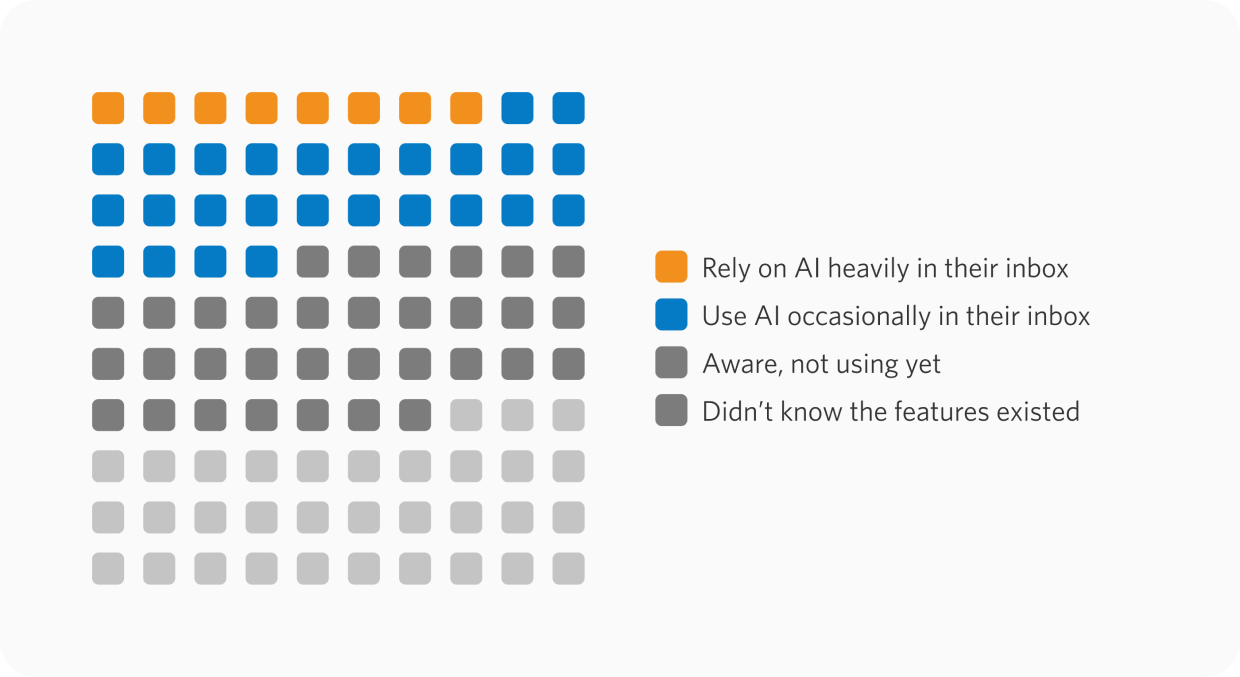
For all the noise about AI, it hasn’t taken over the adviser’s inbox. 34 in 100 use AI-powered features to manage their inbox, and only 8 rely on them heavily. The other 26 use them occasionally, or for specific tasks.
Two-thirds don’t use them at all, and half of that group, a third of all respondents, didn’t know the features existed. Many of them already have these tools in Outlook or Gmail; they just haven’t switched them on.
That gap won’t last. As Microsoft, Google and Apple build AI further into their default inboxes, adoption is likely to come to advisers rather than the other way round. For asset managers, this is the window to get ready.
The summary decides
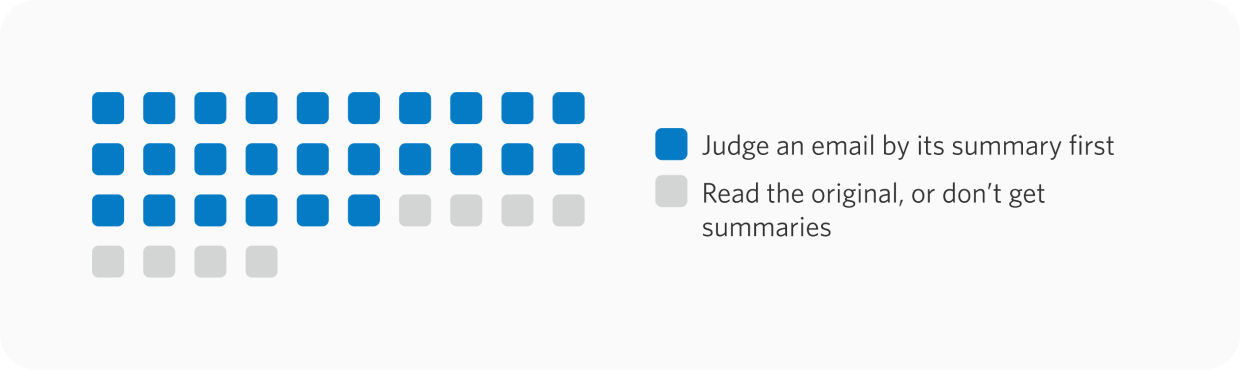
Among those who do use AI, the summary has become the first filter. Of the 34 who use AI in their inbox, three in four judge an email by its summary before deciding whether to open it. 62% read the summary and open the full email only if it looks relevant, and 15% rarely open the original at all.
Summaries are also the most-used AI feature: 68% of AI users rely on them, ahead of drafting replies (47%).
In practice, your email now has two readers: the AI that condenses it, and the adviser who reads the AI’s version. If the point of your email doesn’t survive the summary, it may never reach the person.
There is reassurance too. 47% of respondents say AI hasn’t changed what they read yet, and only 9% of AI users say it has made them miss something time-sensitive. This is a shift to prepare for, not a crisis.
Low trust today, rising reliance
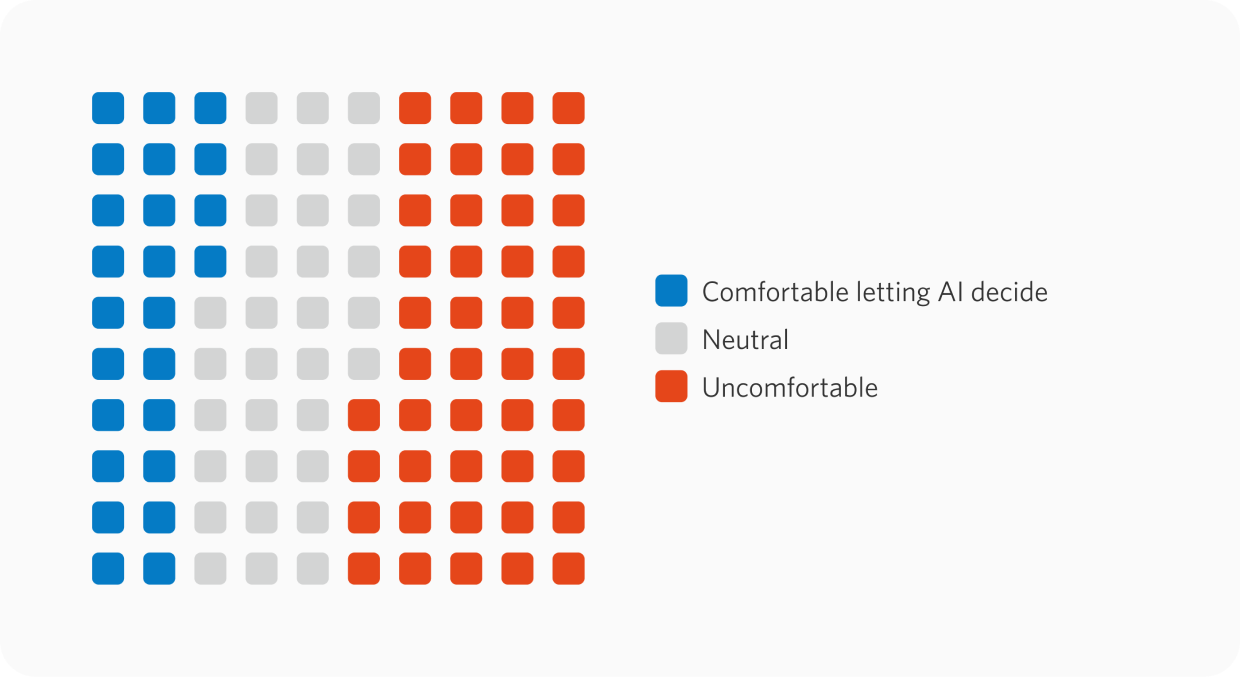
Advisers are wary. 44% are uncomfortable letting AI decide what’s important in their inbox, against 24% who are comfortable. The rest are undecided.
Their concerns are specific to the job. Missing something compliance-relevant tops the list (41%), followed by missing something time-sensitive (35%), losing the personal relationship with the sender (34%) and inaccurate summaries (34%).
But experience changes attitudes. Among those who already use AI in their inbox, half are comfortable letting it prioritise, and half expect to rely on it more over the next year. Among non-users, 44% say they might, depending on how the tools improve.
Trust is low, but it’s building fastest among the people who have actually tried it.
The sender still beats the software
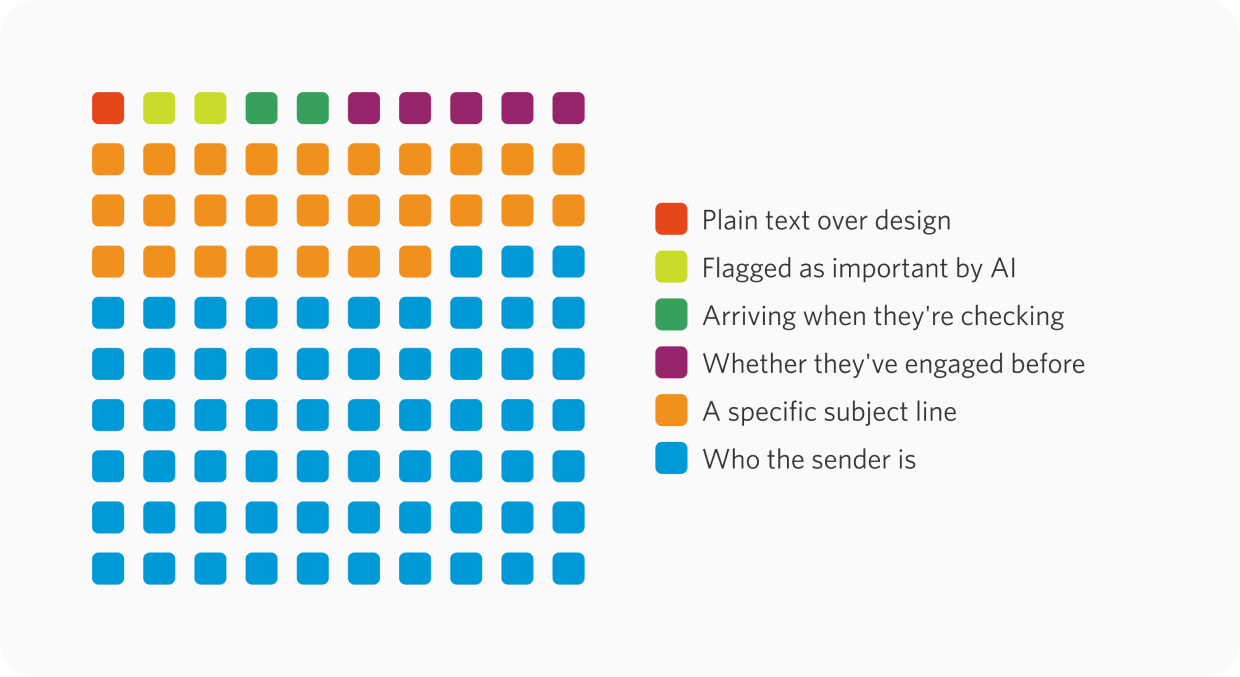
When we asked what most decides whether an investment email gets attention, AI-filtered or not, the answer was clear. 63% ranked who the email is from as the single biggest factor. The subject line came second, ranked first by 27%.
At the other end of the list, only 2% put an AI “important” flag first, and only 1% put plain text over design first.
For all the change in how emails are read, the fundamentals hold. A name the adviser knows and trusts still counts for more than anything an algorithm adds, and the long-running debate over designed versus plain-text emails barely registers with the people receiving them.
Write for the summary
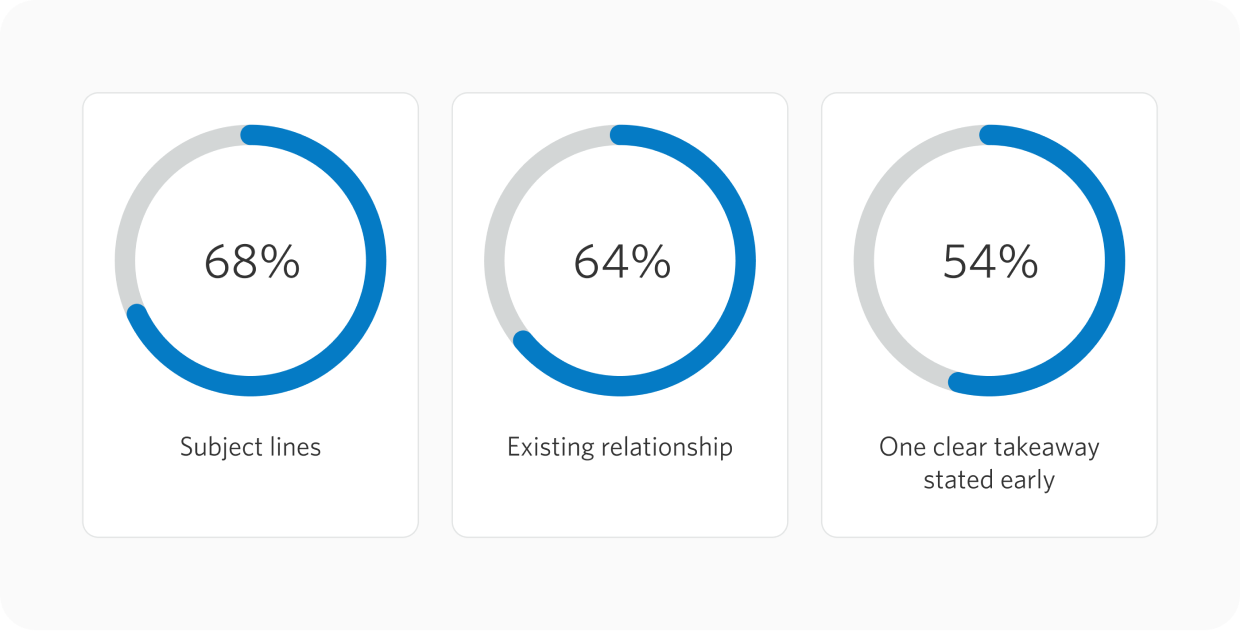
So what gets an investment email through? Advisers pointed to three things: a specific subject line (68%), an existing relationship with the sender (64%), and one clear takeaway stated early (54%).
That last figure rises to 65% among AI users, and it explains a lot. An email that leads with its point is easier for a person to scan, and easier for an AI to summarise accurately. An email that builds up to its point risks having it cut.
The emails that win in an AI inbox are the ones that were already well written: clear about what they say, who they’re from, and why they matter.
A tale of two emails
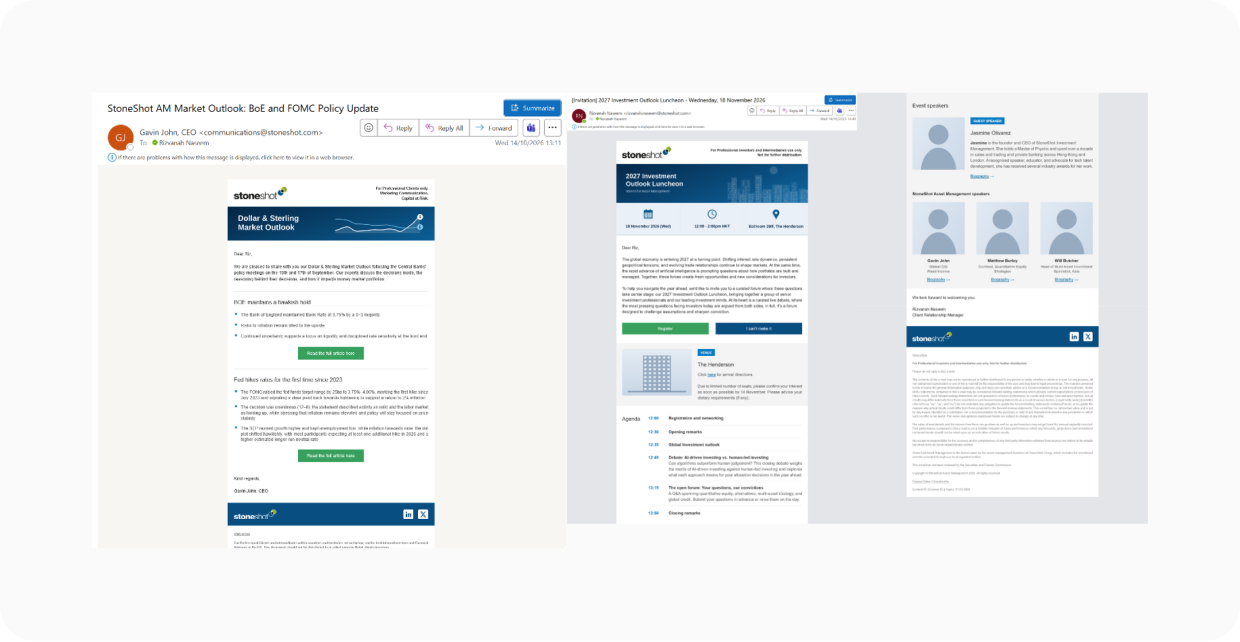
To see this in practice, we took two typical investment emails, a market commentary and an event invitation, and ran each through the three inbox AIs advisers are most likely to meet: Copilot in Outlook, Apple Intelligence in Apple Mail, and Gemini in Gmail.
Copilot in Outlook
Copilot mirrors the structure of the original email. The market commentary summary opened with the sender, then the Bank of England, then the Fed, so whatever comes first in your email comes first in its summary too. The summary box scrolls, so later points may never be seen.
For the event invitation, the date, time, venue, agenda and speakers were all correct, but the reply-by deadline wasn’t shown.
Apple Mail
Apple’s summaries are short, around 50 words. For the market commentary, both policy decisions were kept, but the 6–3 vote was dropped, and the sender appeared only in the email header, not in the summary itself.
For the event, the date, venue and reply-by date were kept, but the time and speakers went.
Gemini in Gmail
Gemini gave the most detailed summaries. It kept both decisions and the 6–3 vote, but it named the sender twice, once wrongly crediting him with a market fact, which is exactly the kind of error that worries compliance teams.
For the event, it picked up both the reply-by date and the request for dietary requirements.
What this tells us
The three tools treat the same email differently, and none of them is fully reliable. Each one dropped or distorted something: a deadline, a detail, or who said what. You can’t control which AI your reader uses, so the safest approach is to write emails that every AI will summarise well.
Takeaways
- Make the subject line the headline. Say what’s inside, not “Market Update”. A specific subject line was the top factor in getting an email through.
- Lead with the point. Put your one takeaway in the first sentence. Summaries follow your structure, so whatever comes first is most likely to survive.
- Send from a person. Use a named relationship manager or fund manager, not “The Team”. The sender is still the biggest factor in whether an email gets attention.
- Keep the facts in live text. Dates, venue and CPD should never be locked in an image. An AI can’t summarise what it can’t read.
- Give your email structure. Bold text, headings, subheadings and bullet points help readers and AI alike find what matters.
- Always include alt text for your images. It helps accessibility, and it gives AI something to work with when an image carries meaning.
- Say who did the thing, in the same sentence as the fact. When attribution is spread across sentences, AI can credit the wrong person, as Gemini did in our test.
From BlackBerry to Bots: our session at FSF
At the FSF Financial Services Marketing Conference, Matt Burley, StoneShot’s Client Services Director, traced more than 20 years of digital marketing in financial services, and how each era has changed who, or what, reads your emails first.
| The BlackBerry era | In 2003, marketers were designing for a stamp: a screen just 160 pixels wide. |
| The glass era | The smartphone changed everything: six times the canvas and 256 times the colours. |
| The consent era | GDPR arrived on one date across 28 countries, and permission became the price of entry to the inbox. |
| Enter the bot | Security scanners now open and click emails before people do. Your most engaged client may be a bot, doubling your opens overnight. See how StoneShot BotShield filters bot opens and clicks out of your reporting. |
| The pixel pushback | Tracking becomes a preference, as France’s CNIL and Italy’s Garante turn their attention to the tiny 43-byte pixel behind every open rate. See how StoneShot ConsentTrack lets each recipient choose open and click tracking separately. |
| The AI gatekeeper | And now, AI is reading first. Which is where this research begins. |
The full session was recorded.
About the research
StoneShot surveyed 100 investment professionals in September 2026: 83 in the UK and 17 in the US. Respondents answered ten questions on how they use AI in their inbox and what determines whether an investment email gets their attention. Where findings refer to “AI users”, the base is the 34 respondents who use AI-powered features to manage their inbox. Percentages may not total 100 due to rounding.
The email tests were run in October 2026. Inbox AI features change frequently, and results may vary by version and settings.


